
Conscious Neurobiology
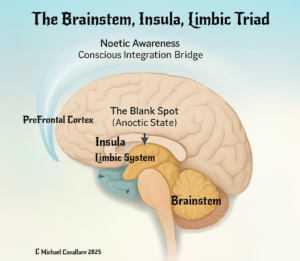 The Brainstem–Insula–Limbic Belief System (BILBS) Model
Abstract
This paper introduces Conscious Neurobiology—an interdisciplinary framework describing how consciousness interacts with neural and physiological systems to shape human experience.
Within this framework, the Brainstem–Insula–Limbic Belief System (BILBS) Model identifies the subcortical architecture through which beliefs are encoded, maintained, and re-patterned.
Experience is first registered as subtle sensory-affective resonance—pre-cognitive vibrational patterning—stored within the triad of brainstem, insula, and limbic structures.
These resonances form implicit programs that govern perception, emotion, and physiology. Through deliberate awareness and applied methods such as the BeliefShift Process and Guardian Protocols, consciousness can reorganize these programs toward coherence and homeostasis.
There are two particular crucial dimensions: the Blank Spot (Anoetic State)—the pre-cognitive gap where belief systems activate—and Noetic Awareness, the conscious faculty capable of perceiving and transforming that gap.
1. Introduction
Conventional psychology and neuroscience acknowledge that emotional conditioning shapes behavior, yet few models describe how meaning is stored in specific neural structures and how awareness can reliably reorganize it.
Conscious Neurobiology bridges that divide. It describes consciousness as both the origin and regulator of biological programs governing human experience.
The BILBS Model specifies a neural-emotional architecture—the brainstem, insula, and limbic network—where perceptual meaning becomes embodied as durable belief patterns.
This model is a synthesis of affective neuroscience, interoceptive research, and the lived study of consciousness. It integrates decades of foundational work that began with Energenetics (1980), evolved through Human Cosmology (1999) and the Guardian Protocols (2004), and was refined into the BeliefShift Method (2010)—now culminating in Conscious Neurobiology (2025), a unifying language for both scientists and practitioners.
Its purpose is simple yet profound: To speak to both the mind and the heart, bridging language between the understood and the felt experience.
2. Theoretical Foundations
- Neurological Basis
• Brainstem — Primal and Vital Life Functions, Safety and Survival
Encodes autonomic tone and threat appraisal, setting the body’s baseline of vigilance or calm. The brainstem is the seat of autonomic regulation working closely with the limbic system (emotions and memory) and the insula (interoceptive awareness). The brainstem activates sympathetic survival responses. This may be known as pre-cognitive activation, which neuroscience widely accepts as the body’s instantaneous protective mechanism.
• Insula — Interoceptive Translation
Integrates sensory and visceral input, creating the subjective feeling of the body’s internal state (Craig, 2009). The insula is the seat of inner sensing. It is a hidden region of the brain, folded deep within the lateral sulcus between the temporal and frontal lobes that translates the body’s internal sensations into conscious awareness. It is through the insula that a person feels themselves or the subtle flow of emotion in the body. It transforms these internal sensations, called interoception, into a felt sense of self. It plays a central role in interoception, emotional processing, self awareness and autonomic regulation.
• Limbic System — Emotional Meaning and Memory
Assigns value and emotional weight, linking experience to motivation and hormonal response (Damasio, 1999). It is the emotional and memory core in the human brain. It is in constant communication with both the brainstem and the insula.
Together these form a continuous feedback loop translating sensation into emotion and emotion into belief.
2.2 Early Programming and Perceptual Interpretation
Early life does not program behavior through events alone but through felt experience and
perceived meaning.
Each child’s nervous system interprets context uniquely; thus siblings in the same home may form opposite beliefs.
The nervous system records not facts but felt truths, storing them as safety maps within the BILBS circuitry.
2.3 Pre-Cognitive Resonance Encoding
Before language or reasoning, experience registers as vibration and tone—a field of resonance rather than thought.
These frequency imprints shape the implicit sense of self and world.
Later stimuli with similar vibrational signatures re-activate those stored patterns, generating emotion before cognition.
Circumstances do not cause reaction; they reveal the encoded resonance awaiting awareness.
3. Mechanism of Belief Programming
Experience → Resonance → Autonomic State → Perception → Belief →Thought → Emotion →
Behavior.
Each repetition strengthens neural-emotional circuits within the brainstem–insula–limbic triad. These circuits become the default expectations through which reality is filtered.
The Pre-Cognitive Physiological Response and the Blank Spot (Anoetic State)
Modern neuroscience confirms that the body reacts before the mind knows why.
Subcortical networks initiate physiological responses in a pre-cognitive window lasting fractions of a second (Damasio, 1999; Craig, 2009; Porges, 2011).
This window, the Blank Spot, is the experiential field between automatic activation and conscious recognition.
Neuroscientists describe this as the anoetic state (Tulving, 2002; Panksepp, 1998): a state of raw feeling without reflective thought.
Within this Blank Spot, the individual feels but does not yet know. It is a purely sensory-affective experience devoid of narrative control.
It is here that belief systems ignite. Old imprints stored in the BILBS architecture interpret the bodily signal, labeling it with learned meaning—danger, rejection, failure, shame, or love.
The interpretation occurs automatically, generating emotion and behavior before awareness intervenes. Thus, in many cases stress, anxiety, and reactive emotion originate not in the cortex but in this pre-conscious ignition zone. Conventional therapy often treats downstream effects; Conscious Neurobiology identifies and retrains the source architecture itself.
3.1 Mechanism of Belief Programming
The Blank Spot / Anoetic State as Ignition Point
Within this sub-second field, belief programs stored through earlier experience awaken automatically. They color raw sensation with meaning before the prefrontal cortex has the chance to interpret or regulate it. This is the missing link between physiology and psychology—the invisible bridge that drives most human behavior yet rarely enters awareness.
People often describe this as sudden anxiety, tension, or loss of control that “comes out of nowhere.” In truth, it arises from the Blank Spot, where the body’s ancient memory speaks faster than language. Because the conscious mind has not yet engaged thus, individuals experience it as involuntary or mysterious. Here stress, panic, and conflict are born; here the nervous system repeats what it once learned to ensure survival.
By acknowledging this space, Conscious Neurobiology offers the first practical doorway into pre-cognitive regulation, working before cognition rather than after. When awareness learns to enter the Blank Spot consciously, the loop begins to change at its origin.
4. The Role of Noetic Awareness
Noetic Awareness is the direct, sensing faculty of consciousness that perceives experience without analysis. It is not thought but presence/awareness itself entering the field of sensation. Where science describes interoception and mindfulness as top-down modulation, this model identifies Noetic Awareness as the active bridge between the cortical and subcortical systems.
When Noetic Awareness perceives the Blank Spot (Anoetic State):
- The amygdala’s dominance begins to
- Prefrontal cortex connectivity re-engages, restoring reflective
- The insula reorganizes interoceptive signals into coherence rather than
- The brainstem resets its baseline of
This process transforms automatic reaction into conscious regulation. The individual learns to feel the earliest vibration of emotion and remain present with it until meaning reorganizes.
Neuroplastic research supports this: mindfulness and compassion training have been shown to decrease amygdala reactivity while strengthening prefrontal-insula pathways (Craig, 2009; Barrett, 2017). Conscious Neurobiology explains why: the vibrational program has been illuminated and rewritten through awareness.
When consciousness enters the Blank Spot, it ceases to be blank. Awareness fills it, and the nervous system remembers how to regulate itself.
5. Consciousness as the Primary Regulator
Epigenetics has revealed how environment shapes gene expression; Conscious Neurobiology moves one step deeper to show that conscious interpretation shapes biology itself.
Meaning, not matter, determines physiological direction.
When awareness shifts perception from fear to understanding, hormonal and neural networks reorganize toward equilibrium.
This is not metaphor: research demonstrates measurable change in heart-rate variability, inflammatory markers, and neural connectivity following conscious reappraisal (Damasio, 1999; Barrett, 2017).
Noetic Awareness therefore functions as both observer and organizer.
It is the regulatory intelligence through which consciousness rewrites the programs of the BILBS system.
Through practice, this awareness becomes stable, guiding biology toward self-healing homeostasis.
6. Mechanism of Belief Reprogramming
Repatterning the BILBS triad engages both bottom-up and top-down processes:
- Awareness Recognition – noticing the first stirrings of sensation before story or
- Somatic Stabilization – breath and grounding restore brainstem
- Interoceptive Clarity – the insula translates signals accurately instead of through
- Meaning Reappraisal – limbic associations update from survival to present
- Conscious Integration – prefrontal networks synchronize with subcortical circuits, establishing new coherence.
This is the practical language of neuroplasticity expressed through consciousness.
Repeated exposure to conscious safety rewires the triad; automatic threat programs dissolve
because their vibration no longer matches the individual’s field.
7. Clinical and Practical Applications
The model complements psychotherapy, somatic therapies, and medical or functional approaches by addressing the perceptual-biological interface directly.
Applications include trauma recovery, chronic stress dysregulation, identity restructuring, and performance under pressure.
Practitioners employ assessment of resonance triggers, interoceptive training, and guided re-patterning protocols such as the BeliefShift Method and Guardian Protocols.
These methods combine awareness, gentle sensory focus, and compassionate inquiry to recalibrate the Blank Spot.
By restoring presence within that space, clients recover choice where none existed before.
8. The Role of Coaching in Neuro-Conscious Reprogramming
Applied Neuro-Conscious Coaching is the relational practice that brings this model to life.
A trained coach acts as a co-regulating presence, helping clients stay aware inside the Blank Spot long enough for Noetic Awareness to stabilize.
Rather than analyze or fix, the coach provides the energetic and emotional safety that allows
the client’s nervous system to reorganize.
This work is developmental, experiential, and collaborative; it complements therapy and medicine by focusing on conscious skill rather than pathology.
Over time, clients learn to become their own coach—meeting sensation with awareness until coherence becomes natural.
9. Implications for Research and Interdisciplinary Practice
Future research may explore measurable changes associated with conscious regulation of the BILBS system:
- Neural: Increased prefrontal–insula connectivity; reduced amygdala
- Physiological: Improved heart-rate variability, cortisol balance, and inflammatory
- Psychological: Enhanced emotion regulation, self-efficacy, and
- Phenomenological: Reports of inner stillness, intuitive clarity, and embodied
Conscious Neurobiology invites collaboration across neuroscience, psychology, medicine, contemplative studies, and consciousness research—linking quantifiable data with lived experience.
10. Conclusion
The Brainstem–Insula–Limbic Belief System (BILBS) functions as the deep infrastructure of perception and emotion.
Within it lies the Blank Spot, corresponding to the anoetic state described in neuroscience—a pre-cognitive field where the body reacts before the mind knows.
Here, stored belief programs automatically ignite, shaping feeling and behavior.
When Noetic Awareness enters this space, the automatic becomes conscious, and biology reorganizes toward balance.
Conscious Neurobiology thus unites science and awareness: the nervous system as instrument, consciousness as the musician.
Through understanding and direct practice, human beings can consciously rewrite the codes of safety, meaning, and connection that shape their lives.
References
- Damasio, R. (1999). The Feeling of What Happens: Body and Emotion in the Making of Consciousness. New York: Harcourt Brace.
- Craig, D. (2009). “How Do You Feel—Now? The Anterior Insula and Human Awareness.” Nature Reviews Neuroscience, 10(1), 59-70.
- Porges, W. (2011). The Polyvagal Theory: Neurophysiological Foundations of Emotions, Attachment, Communication, and Self-Regulation. New York: Norton.
- Barrett, F. (2017). How Emotions Are Made: The Secret Life of the Brain. Boston: Houghton Mifflin Harcourt.
- Tulving, (2002). “Episodic Memory: From Mind to Brain.” Annual Review of Psychology,
53, 1-25.
Panksepp, J. (1998). Affective Neuroscience: The Foundations of Human and Animal Emotions. New York: Oxfor