
Beyond Trauma: Rethinking Healing, Somatics, The Nervous System, and the Human Experience
Beyond Trauma: Rethinking Healing, Somatics, The Nervous System, and the Human Experience
Over the last decade, trauma education, nervous system work, somatic therapies, embodiment practices, and emotional healing have brought enormous value to humanity.
They have helped people recognize that suffering is not merely “mental weakness.” They have helped normalize the reality of emotional overwhelm, physiological activation, chronic stress states, dissociation, shutdown, hypervigilance, and survival responses.
For many people, this has been profoundly validating and life-changing.
And yet, I believe we are now approaching another necessary evolution in how we understand the human experience.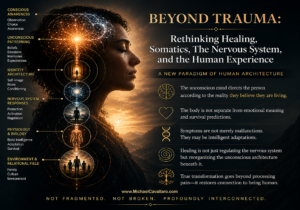
Because while trauma models, somatic frameworks, and nervous system theories have expanded human understanding significantly, I also believe many of these approaches still remain incomplete.
Not entirely wrong. Incomplete. And in some cases, unintentionally limiting.
One of the greatest concerns I have with many modern healing systems is that they often still organize the human being around pathology and body memory.
Even when attempting to help people heal, many frameworks subtly teach individuals to identify themselves primarily through dysregulation, trauma responses, nervous system fragility, triggers, wounds, protective adaptations, attachment injuries, or survival states.
Over time, this can unconsciously reinforce an identity architecture organized around damage.
The person may begin seeing themselves primarily as a traumatized nervous system needing endless regulation, management, monitoring, repair, processing, or protection.
And while these models often begin compassionately, they can sometimes unintentionally deepen identification with suffering rather than reorganize the deeper architecture underneath it.
I believe this is one of the hidden dangers emerging in parts of modern trauma culture. Not because trauma is unreal. Trauma is real.
The body is real. The nervous system is real. Physiology is real. Emotional overwhelm is real. Protective adaptations are real. But I do not believe the human being can be fully explained through trauma alone.
Nor do I believe the nervous system itself is the ultimate originating source of human experience. This is one of the places where my perspective differs substantially from many current somatic and trauma-healing approaches.
Many modern systems describe the nervous system almost as though it independently creates human reality. I do not believe that is entirely accurate. I believe the nervous system is responding to deeper unconscious architecture.
The body is not acting independently. The nervous system is not acting independently.
They are responding continuously to unconscious interpretations, meanings, identity structures, emotional associations, survival predictions, relational conditioning, inherited patterning, and embodied expectations occurring beneath conscious awareness.
In other words:
The unconscious directs the person according to the reality they believes they inhabit.
This distinction matters enormously.
Because if we only focus on regulating physiological states without addressing the unconscious architecture organizing those states, people may experience temporary relief without fundamental reorganization.
The system may calm temporarily while the deeper predictive architecture remains intact underneath. And eventually, the person often reorganizes themself back around the same unconscious meanings, expectations, fears, identities, and survival orientations.
This may help explain why so many people become trapped in endless healing loops. Processing. Regulating. Tracking. Monitoring. Analyzing. Managing. Soothing. Repeating. Yet never fully reorganizing the deeper architecture generating the experience itself.
I believe this happens because many healing systems inadvertently focus too heavily on outcomes rather than origins. The symptom becomes the focus. The dysregulation becomes the focus. The nervous system becomes the focus. But the unconscious architecture producing those responses often remains largely untouched.
And sometimes, the continual focus on symptoms can unintentionally reinforce the very identity structures maintaining them. The person becomes increasingly identified with being dysregulated. Increasingly identified with fragility. Increasingly identified with triggers. Increasingly identified with survival states. Increasingly identified with healing itself.
The healing identity can itself become architecture. This does not mean somatic work lacks value. Far from it.
The body carries immense intelligence. Embodiment matters deeply. Emotional suppression absolutely affects physiology. Trauma absolutely affects nervous system functioning.
But I believe many current models still underestimate how profoundly the unconscious mind organizes human experience beneath the nervous system itself. The unconscious continuously interprets reality:
Am I safe? Am I trapped? Am I powerless? Am I loved? Am I rejected? Am I visible? Am I exposed? Can I survive this?
The person then responds accordingly. Not only emotionally. Not only physiologically. But relationally, behaviorally, perceptually, and existentially.
This means that healing may require something deeper than simply calming the nervous system. It may require reorganizing the unconscious architecture beneath identity, embodiment, emotional meaning, relational participation, and survival prediction itself.
Because human beings are not merely nervous systems. They are living interconnected fields of consciousness, physiology, identity, embodiment, emotion, relational experience, ancestral patterning, environmental participation, symbolic meaning, and unconscious interpretation continuously shaping one another.
This is where I believe modern healing culture sometimes becomes too narrow. Many systems now frame nearly all suffering through trauma language alone. But not every human struggle emerges exclusively from trauma.
Some struggles emerge from identity contradiction. Some from unconscious loyalty structures. Some from inherited family architecture. Some from emotional suppression. Some from existential conflict. Some from relational fragmentation. Some from meaning collapse. Some from deep internal disconnection. Some from archetypal or symbolic layers modern psychology barely addresses. Some from long-standing unconscious predictive models organized around fear, instability, or survival continuity.
And perhaps some dimensions of human suffering still exist beyond our current frameworks entirely. I also believe many current healing approaches unintentionally overemphasize perpetual processing. The person learns to continuously scan themselves for activation, triggers, dysregulation, emotional danger, nervous system shifts, and trauma responses.
But constant internal monitoring can itself reinforce hypervigilance. The individual may unknowingly train the unconscious to remain organized around detecting threat. At some point, healing must also involve re-entering life:
- Participation.
- Embodiment.
- Creativity.
- Connection.
- Meaning.
- Trust.
- Expansion.
- Presence.
- Safety within movement itself.
- Not merely endless observation of pain.
This is another important distinction:
There is a profound difference between integrated awareness and identity-level fixation.
Awareness creates space. Fixation reinforces architecture.
And I believe many people today are unconsciously becoming more identified with their wounds while attempting to heal them. The language of healing can itself become imprisoning when identity reorganizes around it.
This is why I believe true transformation requires something much larger than symptom management or nervous system regulation alone. It requires reorganization of unconscious architecture. The deeper meanings through which reality is interpreted. The survival structures maintaining continuity. The emotional associations attached to identity. The predictive models shaping physiology. The relational expectations shaping perception. The inherited architectures shaping embodiment.
Perhaps most importantly: The gradual recognition that consciousness itself may exist beyond all conditioned structures.
Not beyond the body. Not separate from humanity. Not spiritually dissociated from embodiment. But deeper than the identities, survival patterns, wounds, and unconscious architectures accumulated across a lifetime. I believe healing is not simply learning to manage dysregulation forever. Nor is it bypassing suffering through forced positivity or spiritual ideology.
True healing may involve the gradual reorganization of the entire human architecture through awareness, embodiment, emotional honesty, relational safety, nervous system trust, conscious participation, and integration.
Not war against the self. Not endless analysis of wounds. Not lifelong identification with trauma. But the recovery of a deeper relationship with being human itself.
Because the more deeply I observe humanity, the more I believe that suffering is often not evidence of a broken human being. It is evidence of an adaptive architecture attempting to survive according to the realities it has learned, inherited, embodied, and unconsciously organized around. And perhaps healing begins the moment we stop reducing human beings to diagnoses, trauma identities, nervous system labels, or survival states and begin understanding the far deeper architecture through which human experience is actually lived.