
What Is Love
All You Have to Do to Love, Is Know What You Want
What Is Love?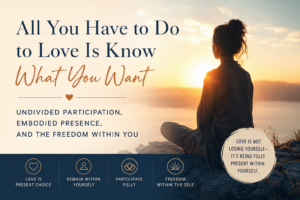
I once had a dream in which one message repeated itself again and again: all you have to do to love is know what you want. At first, that may sound like a statement about desire, as though love means following every impulse, getting whatever you want, or expecting the people and circumstances around you to conform to your preferences. That was not the meaning of the dream. The message was much simpler than that, and much deeper. It was showing me that when you genuinely want to be where you are, with the person you are with, doing what you are doing, love is already present.
If you know that you want to be with someone in this moment, your willingness to be with them is love. If you know that you want to be doing something and you are fully participating in it, you are loving what you are doing. If you have consciously chosen the moment and are not divided against that choice, there is no separation between you and the life you are living. You are not trying to create love or waiting for someone else to give it to you. You are already participating in it.
We usually think of love as something we feel toward another person. We associate it with affection, devotion, loyalty, care, attraction, tenderness, or emotional connection. These can all be expressions of love, but love may exist at an even more fundamental level. It may be the experience of clear, present, undivided participation. When you know what you want and allow yourself to be present within that choice, you are not physically in one place while inwardly wishing you were somewhere else. You are not doing something while resisting it. You are not enjoying yourself while simultaneously warning yourself not to enjoy it too much. You are not entering a relationship or experience while keeping part of yourself outside it in case something goes wrong. You are simply there. In this sense, love is wholeheartedness.
This does not mean that you must know what you want for the rest of your life. It does not mean that every choice must become permanent or that you are never allowed to change your mind. The dream was not speaking about the future. It was speaking about the present. Do you want to be here now? Do you want to be with this person now? Do you want to be doing what you are doing now? Are you willing to participate in the moment you have chosen? When the answer is yes, love may already be present, even if you have never described the experience that way before.
This kind of participation is very different from compulsion. Compulsion may look like devotion or commitment from the outside, but internally it feels very different. Compulsion says that you must continue, must finish, must prove something, or must reach a certain point before you can rest. Love says that you want to be doing this now. Compulsion is driven by pressure and by what is not yet complete. Love is present within the activity itself. You may still work hard, care deeply, or want to finish what you have begun, but the movement comes from participation rather than pressure. The difference may be invisible to everyone else, but you can usually feel it within yourself.
One of the most important parts of this understanding is that your original choice may itself have been love. You chose to be with this person. You chose to enter the relationship. You chose to begin the work, attend the gathering, have the conversation, create the project, or take part in the experience. At the time you made that choice, something within you genuinely said yes. That yes mattered. That yes was love.
The difficulty begins when something happens within the experience that changes how you feel. A person says something you did not expect. A tone, expression, action, disagreement, delay, sensation, or appearance touches something within you. The situation unfolds differently from the way you imagined it would. An old fear, memory, belief, expectation, or protective response comes forward, and you become triggered. Once that happens, you may lose sight of the love that brought you into the experience. You may forget that you wanted to be there, that you chose the person, or that your willingness to participate was itself an expression of love. The reaction that follows may become so strong that it appears to redefine the entire experience. What began in love now feels like the opposite of love.
This does not necessarily mean the original love was false. It may mean that the experience touched something within you that could not remain open in the same way. The love may be real, and the trigger may also be real. You can love someone and still become frightened by something they do. You can genuinely want an experience and still become overwhelmed when it changes. You can freely choose to participate and then discover that part of you is reacting to what has appeared. The later reaction does not automatically erase the truth of the earlier choice.
Another person or circumstance may trigger what you feel, but that does not necessarily mean they created the entire conflict within you. They may touch it, expose it, or bring it into your awareness. Their behavior may activate an old fear, wound, expectation, judgment, memory, or interpretation. The intensity of what follows, however, may come partly from something that was already present within you. This distinction must be handled carefully. It does not mean that other people are never responsible for their actions. People can be inconsiderate, dishonest, controlling, dismissive, unkind, or harmful. Their behavior matters, and nothing about inner responsibility requires you to excuse mistreatment or remain in a situation that violates your dignity or values.
At the same time, the outer event and the whole of your inner reaction are not always the same thing. The event may occur outside you while the conflict awakens what already lives within you. Without recognizing this distinction, you may believe that another person has taken love away from you. You may believe they caused you to stop feeling loved, or you may conclude that because the experience now feels painful, constraining, disappointing, or frightening, it was never love in the first place. Yet something more complex may have happened. You may have moved into protection. You may have interpreted the event through an old belief, judged the feeling that arose, become afraid of what you believed the moment meant, or withdrawn from the experience you originally chose. Love may not have ceased to exist, but you may no longer have been able to experience it.
This may help explain why people sometimes blame others for making them feel unloved. The sequence appears simple: something happens, the feeling of love disappears, and therefore the other person must have taken it away. But there may be several unseen steps between the event and the loss of love. Something happens, you interpret it, the interpretation touches a fear or expectation, a protective response begins, your body and emotions change, and you withdraw from your original participation. You then experience that loss of connection as though it came entirely from the other person.
You may say that they made you feel unloved, took away your joy, trapped you, ruined the experience, or prevented you from feeling free. Sometimes that description may be accurate. Another person may genuinely have acted in a way that created harm, pressure, dishonesty, or constraint. But sometimes they did not create the entire inner experience. They triggered something within you that was already prepared to react. Because you cannot yet see everything that occurred inside you, you place the whole cause outside yourself. You know only that you felt love before the event and did not feel love afterward. You may not yet recognize the interpretation, fear, judgment, bodily response, and protection that came between the two.
This is not about blaming yourself instead of blaming someone else. It is about seeing the whole process. The other person may have responsibility for what they did, and you may also have an opportunity to understand what occurred within you. Both can be true at the same time.
Protection usually begins as an attempt to prevent something painful. A part of you may try to protect you from rejection, humiliation, disappointment, control, shame, vulnerability, loss, unpredictability, or emotional intensity. It may respond by becoming angry, withdrawing, shutting down, criticizing, blaming, attacking, controlling, numbing, or mentally rewriting the entire experience. The intention is often to protect you from pain, but in trying to protect you from the feeling, the protective response may also remove you from love.
It may not remove love from the relationship or circumstance itself. It may remove you from your ability to experience the love that was present in your participation. You stop relating only to what is happening and begin responding to what you fear is happening, what you believe should not be happening, what you think the event means, or what you predict will happen next. You may no longer be present with the person in front of you. You may be present with a memory, an old conclusion, an expectation, or a feared consequence. The moment may not have become entirely loveless. You may simply no longer be meeting it through the same open participation.
The feeling that arises may already be difficult, but the conflict often becomes stronger when you judge the feeling itself. You may decide that you should not feel this way, that the feeling is dangerous, that something must be wrong, or that a loving relationship should never make you feel this way. Now you are not only experiencing the feeling; you are resisting the fact that you are experiencing it. That resistance creates another layer of separation. You may then judge the other person for creating a feeling that you have already rejected within yourself. The outside world becomes the apparent cause of the inner state you cannot accept.
This can lead to the belief that love exists only when no uncomfortable emotion is present. But love may not require the absence of every difficult feeling. Love may also include the capacity to remain in relationship with yourself while the feeling is there. The feeling itself may not be what removes you from love. Your fear, judgment, resistance, or protection against it may be what creates the division.
Love also often carries conditions we do not realize we have created. You may say that you want to be with someone, but underneath that desire you may also require the person to respond in a particular way. You may say that you love an activity, but only as long as it remains pleasant, productive, easy, or within your control. You may say that you want freedom, but only if nothing unexpected happens. You may say that you want joy, but only if the joy does not become so intense that you feel exposed or ungrounded. You may say that you want love, but only if it arrives in a form that your protective system already recognizes as love.
These conditions are understandable. They may have formed through family experience, disappointment, loss, relationships, injury, ancestral patterns, or what you understand as soul memory. They may once have helped you avoid pain, but they can also narrow the space in which love is permitted. You may not simply be choosing the person or the experience. You may be choosing the version of the experience you expect to receive. You want the relationship, provided the other person responds in the way you need. You want the creative process, provided it continues to feel good. You want freedom, provided freedom creates no uncertainty. You want love, provided love never touches the places within you that remain afraid of it.
When reality does not match the internal picture you carried, you may interpret the difference as a lack of love. The actual experience has departed from the anticipated experience, and the gap between them creates conflict. You stop participating in what is happening and begin resisting the fact that it is not happening as you believed it should. The love in the original choice becomes hidden beneath your opposition to the form the experience has taken.
This may also explain why people spend so much of their lives searching for love. We may believe love is something another person must give us. We may believe freedom is something another person must permit. We may believe joy depends upon finding circumstances that never activate our internal conflict. We search for the right partner, the right work, the right teacher, the right spiritual path, the right community, or the right place to live. We hope to find a situation in which we can finally relax, feel secure, participate freely, and allow ourselves to become fully alive.
Yet wherever we go, we bring our existing inner conditions with us. Eventually, the new person or circumstance touches those conditions. The feeling of love begins to disappear, and we conclude that the relationship, work, environment, or experience has constrained us or failed to provide what we needed. Sometimes that conclusion is true. But sometimes the sense of constraint reflects the way we are already relating to ourselves.
We may be restraining our own joy, monitoring our own freedom, opposing our own wanting, or requiring the outer world to remain within very narrow limits so that we do not have to encounter the unresolved conflict within us. What we call a lack of love outside ourselves may reveal the place where we cannot yet remain in loving relationship with our own experience. This is not blame. It is information. It shows us where something within the Self is participating in the loss of felt love.
Present-moment love is not a permanent contract. The fact that you wanted to be somewhere earlier does not mean you must remain there forever. The fact that you chose a person, conversation, relationship, activity, or experience does not mean you are required to continue choosing it after your truth changes. The original choice may have been love, and a later choice may also be love. Continuing may be love, but stopping may also be love. Speaking may be love. Leaving may be love. Resting may be love. Returning may be love.
The difficulty begins when you tell yourself that because you once wanted something, you are no longer permitted to change. You chose this, so you must stay. You wanted this, so you must keep wanting it. You were enjoying yourself, so you must push through. You love this person, so you must tolerate everything. At that point, participation is no longer free. It has become obligation.
Love requires the freedom to participate, but it also requires the freedom to revise your participation. The point is not to force yourself to remain in every experience and call it love. The point is to remain honest enough that your outer participation and inner truth are not compelled to live in opposition.
Many people do not merely struggle to find joy. They also struggle to allow it once it appears. One part of you may want to live fully while another part manages how much living feels safe. One part wants joy while another determines how much joy can be tolerated. One part wants love while another watches for rejection, control, abandonment, disappointment, or engulfment. One part wants freedom while another fears that freedom will lead to danger, vulnerability, chaos, or loss of control.
One part says yes, while another says yes, but not completely.
This internal division creates pressure. Excitement moves outward while protection contracts inward. Joy expands while monitoring restrains it. Desire creates movement while fear interrupts that movement. The difficulty may not come from joy, love, freedom, or excitement alone. It may come from the collision between expansion and prohibition.
The part that restrains is not necessarily your enemy. It may have developed to protect you. It may believe limitation is what keeps you secure. But what once protected you may now interfere with your ability to participate fully in the life you consciously choose. The answer is not to destroy or overpower that part. The answer is to help it discover that awareness, inner authority, discernment, boundaries, and self-location can now provide the safety that restraint once attempted to create.
There are also at least two different ways you may leave your experience of love. The first is to stand outside the experience and monitor it. You watch yourself, evaluate your reactions, and remain prepared for something to go wrong. You never fully enter because part of you is supervising the experience from a distance.
The second appears to be the opposite. You enter the experience so completely that you leave yourself behind. You may become absorbed in another person, a relationship, a spiritual state, a creative act, a feeling of freedom, or something you deeply enjoy. You may believe that wholehearted participation requires you to disappear into what you love.
In the first position, you remain outside the experience in order to stay safe. In the second, you leave yourself in order to become free. Neither position is truly undivided participation. One creates distance through surveillance, while the other creates distance through self-loss. In one, you never fully enter the experience. In the other, you enter but no longer remain fully present as the human being who is living it.
There is another possibility. You can remain deeply and pleasantly located within yourself while becoming fully present in what you love. You do not have to detach, stand outside yourself, or become guarded and watchful. You also do not have to disappear, dissolve into another person, lose yourself in a relationship, abandon your human presence in order to enter a spiritual experience, or leave your body behind in order to feel free.
You can remain aware that you are here, within yourself, while also being fully present with what you have chosen. This is not self-consciousness. Self-consciousness places you outside yourself and asks you to evaluate, supervise, or manage your participation. Embodied self-location is quieter than that. It is the natural awareness that you are present within yourself while also present in the experience.
It is not detachment because you do not have to hold yourself back. It is not guardedness because you do not have to remain tense or prepared for danger. It is not separation because you do not have to create distance between yourself and the person, activity, joy, or love.
You can be present in relationship without becoming lost in the relationship. You can be with another person without placing the center of your being inside them. You can be present in joy without leaving the body behind. You can experience freedom without becoming ungrounded. You can enter spiritual experience without abandoning the human who is experiencing it. You can create without disappearing into the creation.
This may be the fullest meaning of undivided participation. You do not divide yourself by withdrawing from the experience, and you do not divide yourself by abandoning your human center in order to enter it. Human, soul, spirit, conscious awareness, unconscious intelligence, and bodily intelligence can remain present together. The human does not need to vanish so that something larger can be experienced. The larger Self can become present through the human.
Love is therefore not merely being absorbed in what you have chosen. Love is being fully present in what you have chosen while remaining fully present within yourself. This creates a different kind of freedom. It is not freedom from the Self. It is freedom within the Self. It is not the freedom of disappearing. It is the freedom of remaining so securely and pleasantly located within yourself that you can enter life without either withdrawing from it or becoming lost inside it.
At the human level, this understanding restores your right to know what you want. Not what you should want, what proves your worth, what finishes the task, what keeps another person satisfied, or what protects you from judgment. The question is what you honestly want to participate in now.
At the unconscious level, this begins to reconcile competing instructions: move toward what you love, but do not become vulnerable; be free, but do not lose control; enter the experience but remain prepared to escape; enjoy your life, but do not become too alive. The goal is not to destroy one instruction in favor of another. It is to allow conscious awareness, unconscious intelligence, and bodily intelligence to create a form of participation in which presence and safety no longer oppose one another.
At the bodily level, the conflict between expansion and restraint may begin to change. Joy does not have to lift you out of yourself, and protection does not have to pull you away from the experience. The body can remain an active participant rather than becoming the place where opposing instructions collide.
Energetically, clear choice gives movement a direction. When you want what you are doing and remain present within it, energy can move into participation without scattering outward or collapsing inward. Part of you does not have to move forward while another part pulls back. Part of you does not have to expand while another contains it. Part of you does not have to enter while another disappears. Clear choice permits flow, while conflicted choice creates pressure. I offer this as an interpretation of lived experience rather than as a scientifically established law, but it describes something many people can recognize within themselves.
At the level of soul memory, love may have become connected with sacrifice, waiting, restraint, service, renunciation, or the surrender of human desire. Love may have seemed meaningful because it was difficult. Freedom may have required leaving the human behind. Spiritual participation may have been understood as transcendence rather than embodiment.
There is another possibility. Love does not have to be proven through suffering. Freedom does not require disappearance. The human does not need to be escaped so that soul or spirit can become present. The human contributes immediate preference, embodied enjoyment, pleasure, discovery, choice, and lived participation to the larger Self. The soul may contribute wisdom, continuity, developed capacity, and meaning. Spirit may contribute essential direction and orientation. But it is the human who says, “I want to be here now. I want to be with you now. I want to experience this now.” That present willingness gives love a living form.
None of this should be used to excuse mistreatment or to tell someone that another person’s harmful behavior is merely a reflection of their own lack of love. People remain responsible for their actions. Relationships require truth, dignity, boundaries, and mutual respect. Love without discernment can become denial. Love without boundaries can become self-abandonment. Love without truth can become submission to what should be questioned, changed, or left.
The more complete understanding is that an external event and an internal response may both be real. Another person may behave poorly, while your response may also contain an old fear, expectation, wound, judgment, or protective pattern. Recognizing your internal participation does not remove their responsibility. Recognizing their responsibility does not remove your opportunity to become freer. Inner authority allows both truths to remain visible.
Love may therefore be understood as the undivided willingness to participate in what you consciously choose while remaining fully present within yourself. To want where you are is to meet life. To want who you are with is to meet relationship. To want what you are doing is to meet creation. To remain located within yourself while participating is to remain present as the human who is living the experience.
When you no longer want the experience, love may ask you to tell the truth. It may ask you to pause, speak, change, leave, rest, return, or choose again. Love is not always staying, surrendering, enduring, or dissolving into another person or experience. Love is the willingness to remain honest enough that your inner truth, outer participation, and embodied presence are not forced to live in opposition.
The original choice may have been love. A trigger may have interrupted your ability to feel it. Protection may have removed you from the experience of it. Judgment may have convinced you that it was gone. Blame may have placed its entire absence outside you. Self-monitoring may have kept you from entering it, while self-loss may have caused you to disappear inside it.
Love may become available again when you remember that you chose, you wanted, you participated, and you remain here.
A Reflection on Returning to Love
To explore this understanding in your own life, think of a recent experience that began with a genuine yes. It may have involved a relationship, conversation, activity, creative project, social event, spiritual experience, or something you simply wanted to enjoy. Begin by remembering what you originally wanted and why you chose to participate. Before thinking about what went wrong, allow yourself to recognize that your willingness to be there may have been an expression of love.
Then remember the point at which the experience changed. Try to separate what actually happened from what you believed it meant. What was said or done? What feeling arose? What interpretation followed? Did you feel rejected, controlled, ignored, exposed, trapped, diminished, or afraid that something painful would happen next?
Notice what protection attempted to do. Did you withdraw, become angry, blame someone, shut down, take control, criticize, numb yourself, leave, or mentally change the meaning of the entire experience? Consider whether the other person or circumstance created the whole conflict, or whether the event also awakened something that was already present within you.
Do not use this inquiry to excuse harmful behavior or turn responsibility against yourself. Use it to understand the complete interaction between what happened outside you and what occurred inside you.
Then bring your attention back to your own embodied presence. Rather than standing outside yourself and monitoring what you feel, and rather than disappearing into the other person or situation, allow yourself to notice that you are still here. You are the person having the experience. You can remain within yourself while feeling what you feel. You can stay connected without becoming lost, and you can recognize what happened without abandoning your own center.
Finally, ask yourself what you honestly want now. You may want to remain, speak, pause, set a boundary, leave, return later, or choose something entirely different. The purpose is not to recover the original choice at any cost. It is to recover your ability to choose from embodied presence rather than from automatic protection, obligation, self-surveillance, or self-loss.
That may be where love becomes available again, not because the moment has become perfect, but because you are once again present within the life you are choosing.