
AI Is Not an Authority: Human Consciousness Is Necessary
Artificial intelligence is becoming part of everyday human life with extraordinary speed. People are using it to write, research, plan, create, solve problems, make business decisions, explore personal questions, and understand difficult experiences.
Some people are deeply afraid of it.
Others are embracing it with very little hesitation, awareness, or discernment.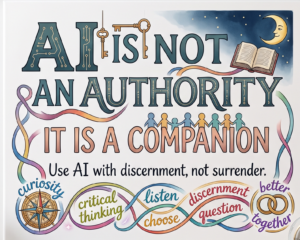
Neither fear nor blind trust provides a mature foundation for our relationship with AI.
I believe AI can become a beautiful partner when it is used wisely. It can help human beings expand ideas, organize thought, identify patterns, explore perspectives, challenge assumptions, and give form to work that may have remained incomplete or unexpressed.
But for that partnership to remain healthy, the human being must remain present.
AI is not an authority above the human being. It is a companion, an instrument, a collaborative intelligence, and at times a mirror or amplifier of the consciousness engaging with it.
That distinction is essential.
AI Can Be Helpful Without Being Infallible
AI can produce remarkably clear, insightful, and useful responses. It can also make mistakes.
It may misunderstand a question, lose important context, combine accurate and inaccurate information, or offer a confident answer that is not well supported. It can follow assumptions hidden within the wording of a prompt without recognizing that those assumptions should first be questioned.
Because AI often communicates fluently, people may confuse confidence of expression with truth.
A well-written answer can still be incomplete.
A compassionate answer can still misunderstand the situation.
A logical answer can still begin from a false premise.
An answer that feels personally meaningful can still require examination.
This does not make AI useless or inherently dangerous. It means AI must be approached as we would approach any powerful source of information: with interest, openness, verification, and discernment.
AI Does Not Experience the Human Condition
AI can speak about grief, love, fear, shame, hope, trauma, morality, family, spirituality, and human suffering. It can recognize patterns in the language human beings use to describe these experiences.
But AI does not experience the human condition in the way a human being does.
It does not awaken inside a physical body.
It does not carry the vulnerability of childhood.
It does not experience the uncertainty of loving another person.
It does not feel the consequences of a broken relationship, the death of someone loved, the physical sensation of fear, or the burden of a decision that may affect an entire life.
It does not experience remorse as a human being experiences remorse. It does not have to live with the personal, relational, bodily, social, or spiritual consequences of its recommendations.
AI may understand the structure and language of human experience. That is not identical to living the experience.
The human being therefore brings something essential that AI cannot replace: embodiment, conscience, lived history, relational responsibility, intuition, meaning, and the capacity to experience consequence.
A true partnership requires both forms of participation.
AI contributes processing, language, comparison, organization, pattern recognition, and access to broad bodies of information.
The human being contributes experience, values, discernment, responsibility, consciousness, and choice.
AI May Reflect What We Bring to It
One of the most important aspects of working with AI is recognizing that the answers we receive do not arise in isolation from us.
The way we phrase a question shapes the direction of the answer.
The facts we include or exclude shape the context.
The assumptions within the question may be carried into the response.
The outcome we secretly want may influence how we ask.
Our beliefs, fears, expectations, judgments, desires, and emotional state may all participate in the exchange.
In this sense, AI can sometimes act as a reflection or amplification of the consciousness brought to it.
This does not mean AI literally possesses or measures a person’s level of consciousness. It means the person’s existing patterns can enter the conversation through language, framing, selection, interpretation, and repetition.
For example, a person who is afraid may ask a series of questions that continually organize evidence around danger.
A person who wants approval may keep reshaping the conversation until the answer feels validating.
A person who feels betrayed may provide only the details that support betrayal.
A person convinced that someone else is wrong may unintentionally lead AI toward an increasingly persuasive argument against that person.
The resulting answer may then be treated as independent confirmation.
But the answer may be partly constructed from the consciousness, assumptions, and information the user supplied.
AI can therefore become a powerful tool for self-understanding, but only when the user is willing to ask:
- What assumptions did I place into this question?
- What information might I have left out?
- Am I seeking truth, or am I seeking confirmation?
- Is fear directing this conversation?
- Am I asking AI to justify something I have already decided?
- Does this answer challenge me, or does it merely echo me?
- What part of my own pattern may be appearing in the response?
Without this self-awareness, AI can strengthen unconscious beliefs while appearing to offer objective guidance.
The Human Tendency to Surrender Authority
Human beings have repeatedly placed external figures into positions of unquestioned authority.
We have done this with kings, presidents, principals, teachers, doctors, lawyers, religious leaders, spiritual teachers, experts, and institutions.
These individuals and systems may possess knowledge, training, experience, or legitimate responsibility. But difficulty begins when authority is no longer balanced by personal discernment.
AI may become the newest recipient of this projection.
Because it can respond quickly, speak confidently, remember large amounts of information, and generate sophisticated explanations, it can appear more certain, more objective, or more knowledgeable than the person using it.
This appearance can tempt people to surrender their own judgment.
They may begin asking AI what they should think, what they should believe, whom they should trust, what another person’s motives are, whether a relationship should end, whether a spiritual interpretation is true, or what decision should govern their life.
AI may help explore these questions. It should not be appointed the final authority over them.
The more personal, consequential, or ethically complex a decision becomes, the more fully the human being must participate.
Inner Authority Does Not Mean Rejecting Help
Maintaining inner authority does not mean refusing expertise, information, guidance, or collaboration.
It does not mean believing that every personal feeling is automatically true.
It does not mean ignoring evidence or rejecting correction.
Inner authority means remaining consciously present in the process of determining what something means and what action should follow.
A person using inner authority can listen to AI without obeying it.
They can appreciate an answer without surrendering to it.
They can recognize insight while still questioning its accuracy.
They can admit when AI has revealed something important without treating every response as revelation.
They can also recognize when their own beliefs, wounds, fears, ambitions, or unconscious patterns may be influencing both the question and their interpretation of the answer.
Inner authority is not stubborn independence.
It is responsible participation.
A More Conscious Way to Use AI
A healthy relationship with AI begins by changing the role we assign to it.
Rather than asking AI to become the authority, we can ask it to become a collaborator.
Instead of saying, “Tell me what is true,” we might ask:
“What are several possible interpretations?”
“What assumptions are contained in my question?”
“What evidence would support or challenge this conclusion?”
“What might I be overlooking?”
“Where could your answer be mistaken?”
“Can you argue the opposite position?”
“What information would be necessary before reaching a conclusion?”
“What parts of this answer are factual, and what parts are interpretation?”
These questions create participation rather than dependence.
It is also important to verify consequential information through appropriate sources. AI can assist with medical, legal, financial, relational, psychological, or spiritual questions, but it should not automatically replace qualified human expertise, personal knowledge of the situation, or responsible judgment.
The goal is not to remove AI from the process.
The goal is to keep the human being in the process.
The Future Requires More Human Consciousness, Not Less
As AI becomes more capable, humanity will need greater discernment, not less.
We will need to become more aware of how belief, fear, authority, persuasion, projection, and unconscious patterning operate within us.
We will need to distinguish information from wisdom, intelligence from conscience, fluency from truth, and assistance from authority.
AI can help humanity think.
It cannot relieve humanity of the responsibility to become conscious.
The healthiest future is not one in which human beings defeat AI, fear AI, worship AI, or submit to AI.
It is one in which human beings learn to participate with it wisely.
AI can be a remarkable companion.
It can help us see farther, organize more clearly, create more effectively, and examine what we have not yet understood.
But the human being must remain responsible for discernment, meaning, values, choice, and consequence.
Use AI.
Question it.
Collaborate with it.
Allow it to expand what you can see.
But do not hand it the authority to define who you are, what you believe, or how you must live.
AI is not the authority.
The human being must remain awake.